|
The
English word cat
dates from before 900A.D. -
comes from the Old English words: catt (male)
and catte (female). The
word comes from Old High-German / Old Norse
words.
|
A bag of cats
- A
bad-tempered person, such as: "She's a
real bag of cats this afternoon!"
|
A
cat in gloves catches no mice - Sometimes
you can't accomplish
a
goal by being careful and polite.
An
idiom attributed to Ben
Franklin in Poor Richard's Almanac
|
All
cats are gray in the dark - All
persons are undistinguished
until
they have made a name.
English
proverb
|
Alley
cat - A stray or homeless cat.
The
"alley" portion probably
refers to prostitutes, who at one point
literally carried a mattress
around
with them. The "cat" probably alludes
to the mating habits of
female
cats.
|
| Another
breed of cat - something different
from anything else |
As much chance as
a wax cat in hell
- There is
no chance at all.
|
As
nervous as a cat in a room full of rocking
chairs - Someone
with
frayed nerves; jumpy
The
allusion, of course,
is to the fact that cats don't like having
their tails tromped
upon.
Where the phrase originated is unknown.
|
Busier than a
one-eyed cat watching two
mouse holes - Very busy,
almost to the point of being frantic
|
| Busier
than
a
three
legged
cat in a dry sand box
- Very
busy, almost to the point of being
frantic |
| Cat-and-dog
- Resembling or
having the character of the proverbial
antagonism between cats and dogs. |
Cat
around - To live an aimless,
immoral life
|
Cat
burglar - A nimble, silent, sneaky
thief
Refers
to the way cats are
able to sneak up and steal their prey
|
Catcalls
- Booing bad acting
The
expression goes back
to the theatre of Shakespear's time, when
men criticized the acting by
making noises that sounded like a fence full
of cats.
|
Caterwauling - Making
harsh
noises or cries
|
Cat-eyed
or cat eyes - Able to see in the
dark
Coined
in recognition of
a cat's ability to see in very low-light
conditions.
|
Cat
got your tongue - Why aren't you
talking?
The
phrase probably comes
from a custom in the Mideast hundreds of
years ago, when it was common
to punish a thief by cutting off their right
hand, and a liar by
ripping
out their tongue. These severed body
parts were given to the
king's
pet cats as their daily food.
|
Catgut
- What tennis rackets and violin
strings are made of
The
word came about when
the German word "kitgut" was
translated into other languages. Kitgut
was
a small fiddle. The folk tale "cat and
the fiddle" probably has
something
to do with the translation as well. Catgut
was usually made from sheep
or goat, or occasionally other animals like
the horse, pig or donkey --
never from a cat.
|
Cat ice
- Thin,
dangerous ice
Ice that would
not
support a cat, similar to the phrase
"skating on thin ice."
|
Cat-in-hell
chance
- No
likelihood
of
success
It originally
referred to the hopelessness of fighting
with inadequate weapons.
(The complete phrase is: "No more chance
than a cat in hell without
claws.")
|
Catkins
- fluffy flower bracts of willow and
birch trees
The
catkins look like small
cats' tails. (Other plants refer to
cats also: pussy willow
and cat tails.)
|
| Catlap
- Usually weak tea or milk;
something fit only for cats to drink |
Catnap
- Sleeping for a short period of
time
Reference
to the ability
of a cat to sleep frequently and lightly
|
Cat
o'nine tails - A whip
In
olden days, people were
flogged by a nasty device made up of three
separate knottings of three
stands attached to the whip's handle. While
the strands may have
been made from the hide of cats, the
multiple of 9 had already been
associated
with cats; presumably if a person being
flogged survived, they were as
lucky as a cat with 9 lives.
|
Cat's
cradle - A string game played by
children
In
early Europe, people believed a cat
could increase the chances of
fertility in a young married
couple. A month after the wedding,
a
fertility rite was performed, where a
cat was secured in a cradle, and
the cradle was then carried into the
newlyweds' house and was then
rocked back and forth. This
ensured an early pregnancy. The
string game creates what looks loosely
like a cradle, and over time it
was called a 'cat's cradle.'
|
Cat's
eye - Precious or semi-precious
gems that have a changing
luster;
also road markers which reflect car lights
(invented by Englishman
Percy
Shaw)
Refers
to the coloring similar
to a cat's and to the reflecting of light in
a cat's eyes
|
Cat's
foot - To live under the cat's
foot is to allow someone to
control
you.
Phrase
was coined in reference
to the behavior of a cat with a mouse or
other "toy."
|
Cat's
concert / cats in chorus / cat's melody -
Making harsh noises or
cries
Probably
came from Shakespeare's
play Twelfth Night: “What a caterwauling do
you keep here!” (see
also Caterwauling)
|
Cat's meow - Something
considered
to
be outstanding
Coined
by American cartoonist
Thomas a. Dorgan (1877-1929) whose work
appears in many American
newspapers. (see also Cat's whiskers)
|
Cat's
pajamas - Something considered
to
be outstanding
The
term "cat's pajamas"
comes from E.B. Katz, an English tailor of
the late 1700's and early
1800's, who made the finest silk pajamas for
royalty and other wealth
patrons. Nothing like a cat nap in
Kat'z pjs. (from the book,
"Cats
out of the Bag" compiled by Terry, Don and
Ken Beck)
Alternative:
A slang phrase
coined by Thomas A. Dorgan in the 1920s when
the word "cat" was used as
a term to describe the unconventional
flappers from the jazz era. This
was combined with the word pyjamas (a
relatively new fashion in the
1920s) to form a phrase used to describe
something that is the best at
what it does, thus making it highly sought
and desirable.
|
| Cat's paw -
To be labeled a "cat's paw" means
someone has taken advantage
of you and you weren't smart enough to
"cat"ch on.
Also (for sailors): Cat's paw means a brisk, skittish
breeze that might catch you unawares ~ the
way a playful cat might paw you.
The
phrase has its origins
in an old folk tale in which a clever monkey
tricks a cat into reaching
into a fireplace to pull out some roasting
chestnuts. The monkey
got the chestnuts, but the cat got burned.
|
Cat's
whisker - before
diodes
were
invented,
people
made a kind of diode by touching
a long thin wire against a germanium
crystal. This was enough to
rectify a radio signal to the point where it
could drive a single earpiece. The radio
was a "crystal set" and
the long wire was the "cat's whisker".
Presumably, the
wire
was nicknamed as such because it looked
similar to cats' whiskers.
|
Cat's
whiskers - Something considered
to
be outstanding
Coined
by American cartoonist
Thomas a. Dorgan (1877-1929) whose work
appears in many American
newspapers. (see also Cat's
meow)
|
Catty
remarks - Comments made by a
woman, usually about another woman
The
phrase came about when
a man named Heywood, in the middle 1500's
wrote "A woman hath nine
lives
like a cat." Soon, a woman who
gossiped about other women was
said
to be making "catty" remarks about them.
|
Catwalk
- A narrow walkway
Termed
as such because of
a cat's ability to balance in very narrow
places
|
Clowder
of cats - a group of cats
There is a 15th
century reference to clouder and later
crowder in the book of St Alban.
It meant a variety of things but mainly a
crowd, or cluster, clotting,
coagulating. It appears to be a word which
predates the Mayflower
pilgrims who sailed from Plymouth by a
couple of hundred years.
|
Cool
cat - Someone who keeps up with
the latest trends.
The
term came about in
the Roaring 20's, and ita meaning hasn't
changed. (see also Hep
cat)
|
Conceited as a
barber's cat - very conceited
|
Copycat
- A person who copies others
Probably
a reference to
the way kittens learn by copying their
mother's actions.
|
Couldn't cuss a
cat without getting fur in
your mouth - referring to
tight, cramped spaces
|
Curiosity
killed the cat - Be cautious when
investigating situations.
The
saying originally was
"care kills a cat," and began in the 16th
century. "Care" was a
warning
that worry is bad for your health and can
lead to an early grave; the
phrase
was a recognition that cats seem to be very
cautious and careful. Over
time, the word "care" evolved into
"curiosity."
|
Dead cat
bounce - An automatic recovery in a
financial
market.
Refers to the
lore
that a cat 'bounces back' from death many
times.
|
Dead cat
on the line - Something
suspicious or 'fishy' is going on
Refers to
fishing for
catfish. The lines are checked every day, so
if there's a dead catfish
on the line, there's something wrong.
An alternative definition, sent in by a
reader: Science
Magazine,
about the early 1980's had and article about
colloquialisms and the
like. The term Dead cat on the line is
an expression from
the mid 70s and earlier when many folk
had party lines still
for their telephone service. If someone was
listening in you would hear
a click. The way one speaker would alert
another to keep the
conversation off confidential subjects would
be to say, "there's a dead
cat on the line."
|
Dog my cats
- An
expression of astonishment, similar to
"Well,
what do you know!"
Possibly
originally coined by O.Henry
(1862-1910) in his short story "Memoirs of
a Yellow Dog."
|
Dust kitten
- A clump
of dust/lint (similar to "dust
bunny")
|
Enough
to make a cat laugh - Something
that is ridiculously silly.
Cats
don't laugh.
|
Fat
cat - A wealthy and privileged
person
Cats
that are well-fed and
cared for are seldom skinny; hence, a person
living the good life is a
fat cat.
|
Fight like
cats and dogs - To
quarrel
viciously.
|
Fight
like Kilkenny cats - To fight until
both parties are destroyed
Lore
has
it
that
in
the ancient
town
of
Kilkenny,
on
the River Nore in south-east Ireland, bored
soldiers would tie two cats together for
sport until they killed each
other. This is a
popularized limerick about Kilkenny cats:
"There wanst
was two cats of Kilkenny
Each
thought
there was
one cat too many
So
they fought
and they
fit
And
they
scratched and
they bit
'Til
instead of
two cats
there weren't any."
|
Glamour
puss - A glamorous lady
Probably
derived from the
ancient word "buss" which means "face," esp.
the lips. Over time,
the word began to be pronounced as "puss,"
associating it with the cat.
A reference to the sleek pose of a cat
|
Grinning
like a cheshire cat - Displaying a
silly grin
From
the Lewis Carroll novel
(written in 1865), Alice's Adventures in
Wonderland
|
Having
kittens/had kittens/has kittens
- A state
of rage, similar
expression to having a fit, going ballistic,
losing your temper
In medieval
times it was believed that if
a pregnant woman was in pain, she had been
cursed by a witch and had
kittens inside clawing at her belly.
Witches, they believed,
could control cats, and could eliminate
the kittens. Since a
woman believing she was going to give
birth to a litter of kittens
would become hysterical, the phrase has,
over time, come to mean being
in an angry panic.
|
Hellcat
- A bad-tempered woman
Refers
to the hissing and
spitting of an angry feline
|
Hep cat -
Someone who keeps up with the
latest trends.
The
term came about in
the Roaring 20's, and its meaning hasn't
changed. (see also Cool
cat)
|
High as the hair
on a cat's back - Very expensive
|
Honest
as
the
cat
when
the meat's out of reach - Will
not
steal
if
he's
likely to be caught.
|
Hotter than a six
peckered alley cat
- A person
of loose morals
|
I
smell a rat - Thinking there is
something hidden or concealed
The
allusion, according
to Brewer's Dictionary of Phrase and
Fable, is to a cat
smelling
a rat.
|
It's
raining cats and dogs - It's
raining very hard
The
dog, an attendant of
the storm king Odin, was a symbol of wind.
Cats came to symbolize
down-pouring
rain, and dogs to symbolize strong gusts of
wind. A
very heavy storm, therefore, indicated that
both cats and dogs were
involved.
Another explanation is that the phrase came
about in early 17th-century
London, when cats hunted mice on the
rooftops - during a rainstorm, the
cats were washed off the roofs and fell on
passersby.
|
Keep no more cats
than will catch mice
- Don't
surround yourself with
people who will be dependent on you.
|
Let
sleeping cats lie - Leave things
as they are
A
French proverb
|
Like
a cat on hot bricks - Someone
with
frayed
nerves;
jumpy
A
similar English phrase is "Nimble as a cat
on a hot
bake-stone or "like
a cat on a
hot tin roof,"
which means in a hurry to get away (a
bake-stone was a large stone on
which
bread was baked).
|
Like
a cat on a hot tin roof - Someone
with frayed nerves; jumpy
The
phrase originated in
Tennessee Williams' play of the same
name. As then, it indicates
someone who is jumpy - behaving like a cat
would if they were on a hot
tin roof. A similar English phrase is
"Nimble as a cat on a hot
bake-stone or "a cat on
hot bricks,"
which
means
in
a
hurry to get away
|
Like
cats and dogs - Usually,
quarreling viciously (as in "fighting like
cats and dogs")
|
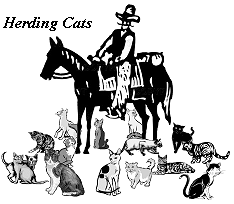
| Like
herding cats - An effort that will
likely be
futile or at
least
very, very difficult to accomplish. |
| Looking
like a cat that swallowed a canary -
Displaying
a self-satisfied grin |
Look
what the cat dragged in - A
slightly derogatory comment on
someone's
arrival
Origin
unknown, but an obvious
reference to cats' tendency to bring home
its prey, tattered and torn
after
"playing" with it for a while.
|
Make
the fur fly - Start a fight
Possibly
a reference to the nursery rhyme The
Gingham Dog and the Calico Cat;
certainly
a reference to a cat and dog fighting.
|
Morals of an
alley cat and scruples of a
snake - An amoral,
unscrupulous person
|
Playing
cat and mouse - Playing a game of
strategy and stealth, or
playing in a cruel or teasing way.
|
Pussyfooting
around - To
tread or move warily or stealthily or to
refrain from committing oneself
This
phrase started out
as a comment that cats are stealthy and
somewhat sneaky when hunting. The term is
American
in origin and dates to at least 1893.
|
Put
the cat among the pigeons - A
British term which means to cause
an enormous fight or flap, usually by
revealing a controversial fact or
secret.
When
Britain governed India,
a popular pasttime was to put a wild cat in
a pen with pigeons - bets
were
then taken to see how many birds the cat
would bring down with one
paw-swipe.
|
Rub
someone's fur the wrong way - To
irritate or upset someone
Reference
to the annoyance
a cat displays if his fur is stroked
backwards.
|
Scaredy-cat
/ Fraidy cat - A person who won't
act on a dare, or who is
afraid
to try something new.
The
phrase was coined in
recognition of a cat's trait of not standing
up against a dog many
times
its size.
|
See
which way the cat jumps - Wait and
see what happens
A cruel
sport in the olden
days was to place a cat in a tree as a
target; the "sportsman" would
wait
to see which way the cat jumped before
pulling the trigger.
|
She's the cat's
mother - A
rebuke
A rebuke to
someone
who refers to a woman as 'she' instead of by
her name, either formal or
informal. The 'she' in the phrase is the
female of a cat, the male
being a 'tom', and is not to be applied to a
woman when you're in her
company.
|
Sitting
in the catbird seat - Being in an
advantageous position
(alludes to a bird's
The
first recorded usage was in a 1942 humorous
short story
by James Thurber titled "The Catbird Seat."
"In the catbird seat" was
among the numerous folksy expressions used
by baseball broadcaster Red
Barber.
|
Sourpuss
- Someone who is cranky
Probably
derived from the
ancient word "buss" which means "face," esp.
the lips. Over time,
the word began to be pronounced as "puss,"
associating it with the cat.
|
Sweeten
the kitty - Increase the amount
In faro, the
"tiger"
was the bank of the house. Gamblers called
the tiger a kitty, and thus
"kitty" became the name for the payout in
various card games.
Sweetening or fattening the kitty, then,
means increasing the pot or
improving the deal.
|
Tabby
- A domestic cat with a striped
and mottled coat
The
silks created by weavers
in Baghdad, Iraq, were inspired by the
varied colors and markings of
cat
coats. These fabrics were called
"tabby" by European traders.
|
The
cat may look at a king - An
insolent remark of insubordination,
meaning, "I am as good as you".
An
English proverb, or possibly
originated from the nursery rhyme.
|
The
cat's out of the bag - To pass
along a secret.
In
medieval England, piglets
were sold in the open marketplace. The
seller usually kept the
pig
in a bag, so it would be easier for the
buyer to take it home.
But
shady sellers often tried to trick their
buyers by putting a large cat
in the bag. If a shrewd shopper looked
in the bag - then the cat
was literally out of the bag. (By the
way, the bag was called a
"poke,"
which is likely where the phrase "a pig in a
poke," which nowadays
means
buying an unknown, came from.)
An
additional interpretation was submitted by
a reader:
In
nautical
lore, a cat-o-nine had to be made new for
each
flogging. The whip was made, then
put into a bag and held while
the charges were listed. Then, just
before the flogging, the cat
would be brought out of the bag. In
this usage, the phrase "the
cat's out of the bag" meant something akin
to "punishment is about to
begin" or "the belt's off."
|
There's
more than one way to skin a cat - There
is more than one way to
accomplish a task.
The
reference is to preparing
a catfish (named as such because of its long
whiskers) for cooking,
which
must be skinned because the skin is tough.
|
There's
not enough room to swing a cat - The
room is very cramped and
crowded.
In the
olden days, sailors
were punished by being whipped with a cat
o'nine tails (see above).
Below
deck, there wasn't enough room to lash the
whip, so the punishment was
given on deck, where there was "enough room
to swing the cat."
|
To
bell a cat - To do the
impossible. It is easily
suggested,
but once suggested, no one will volunteer
to do it.
From
Aesop's fable, The
Belling of the Cat
|
To
get one's back up - Showing anger
or annoyance
The
allusion is to a cat,
which sets its back up when attacked by a
dog or other animal.
|
To
live a cat and dog life - To
always be arguing
Phrase
was coined by Carlysle
in his book Frederick the Great: “There
will be jealousies, and
a cat-and-dog life over yonder worse than
ever.”
|
Tomcat
- A male who enjoys the favors of
many women.
The
expression comes from
a book written in the mid-1700s in England
called The Life and
Adventures
of a Cat. The "hero" of the
book, a male cat who enjoyed the
favors of many female cats, was named Tom.
|
Walk
like a cat on eggs - Tread very
lightly
|
Walk the
cat back - To attempt to understand the true
nature
of a situation by reconstructing events
chronologically from the
present to the past
Earliest
citation 'I
find it inconceivable that anybody could
walk the cat back,' lamented
Mr. Petty," The New York Times article by
Robert A. Bennett, February
19, 1984
|
Weak as a kitten
- Very
weak, ineffective, fragile.
In the early
1800s
the expression was weak as a cat
|
| When
the cat's away, the mice will play - Without
supervision,
people
misbehave. |
|
| Idioms: |
a manner
of speaking
that is natural to native speakers of
a language. |
 |
See also
|
Taglines
and
Quotes and Folklore,
Superstitions,
and Proverbs |
|
Tagline: |
an ending
line that
makes a point. |
|
Folklore:
|
the
traditional
beliefs, myths, tales, and practices
of a people, transmitted orally. |
|
Superstition: |
an
irrational belief
arising from ignorance or fear. |
|
Proverb: |
old and
popular
saying that illustrates something such
as a basic truth or a practical
precept. |
|
|
|
|
|
|
|
|
|
|
|
|
|